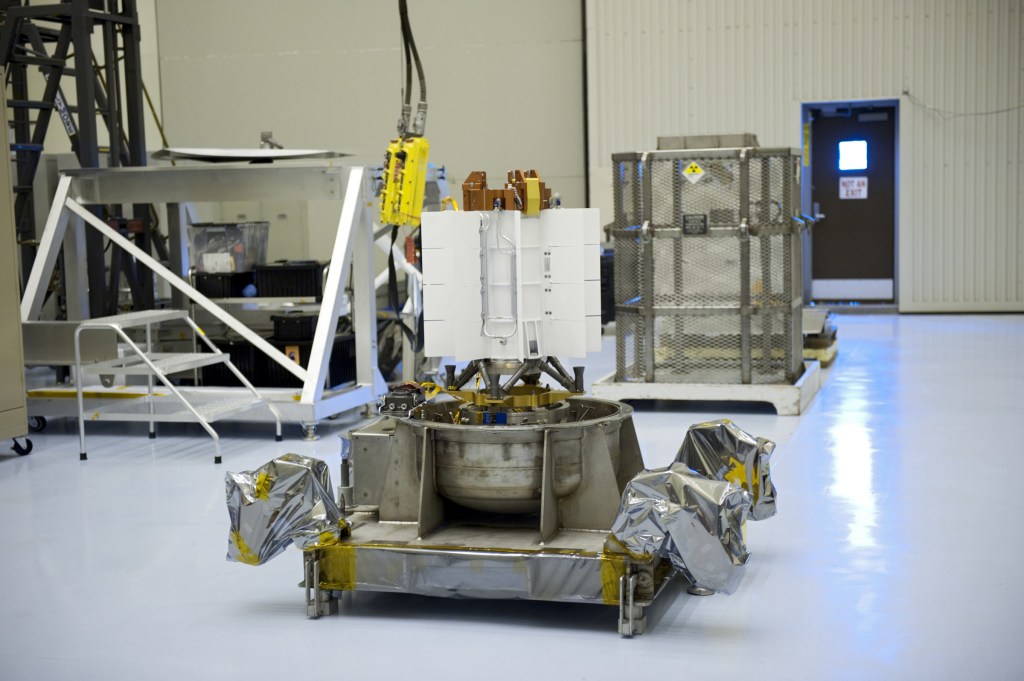
The US Department of Energy (DOE) has delivered the nuclear power system for the Perseverance rover for NASA’s Mars 2020 mission which is due to launch next month. The Multi-Mission Radioisotope Thermoelectric Generator (MMRTG) was fuelled, built and tested by DOE’s national laboratories.
Radioisotope power systems (RSPs) convert the heat generated by the natural decay of plutonium-238 (Pu-238) into electrical power. The MMRTG will supply electricity for the basic operation of the rover and maintain its tools and systems at optimum temperatures. It has an operating life of 14 years.
MMRTG Inside Out
The DOE restarted US production of Pu-238 in 2015 for the first time since 1988. It now maintains an essential infrastructure to help NASA fuel, build and test RPSs. Perseverance will be the first plutonium rover to be used by DOE’s Oak Ridge National Laboratory (ORNL), which, along with Idaho and Los Alamos National Laboratories, is working to increase U.S. production of Pu-238 for deep space exploration. ORNL automated part of the production process in February to produce up to 400 g of Pu-238 per year, bringing NASA ‘s target of 1.5 kilograms per year by 2025 closer.
The RPS for Perseverance was assembled, tested and delivered to the Kennedy Space Center in Florida by the Idaho National Laboratory (INL). The laboratory team will monitor the power system around the clock until the launch of the United Launch Alliance Atlas V 541 rocket, currently scheduled for 9:15 a.m. EDT on 17 July. Perseverance will land on Mars in February 2021 and spend at least one Mars year (two Earth years) exploring the landing site region, an ancient river delta in a lake that once filled the Jezero Crater planet.
DOE’s next MMRTG is scheduled to fuel Dragonfly’s rotorcraft mission to explore Saturn’s largest moon, Titan. The mission is scheduled to launch in 2026, arriving at Titan in 2034.
Plans for a clean economic recovery and therefore the goal of ‘Net Zero by 2050’ need commitment to new atomic power plants, the UK’’s Nuclear Industry Association (NIA) said today. before the global climate change Committee’s annual progress update due in the week , the NIA has released Forty by ’50: A Nuclear Roadmap, an assessment produced for the govt and industry body, the Nuclear Industry Council (NIC).
The NIC-endorsed report says that, additionally to helping meet future goals, prompt decisions on a replacement nuclear power programme could “unlock mega-projects” delivering immediate benefits to help tackle the impact of COVID-19, the NIA said. An “ambitious programme” could provide up to 40% of unpolluted power by 2050 and “drive deeper decarbonisation” through the creation of hydrogen and other clean fuels, in conjunction with district heating, and eventually bring as many as 300,000 jobs and GBP 33 billion of “added annual economic value”, it said. nuclear energy provides 40% of the UK’s clean electricity, but demand is predicted to quadruple from the replacement of fossil fuels and a boom within the electric vehicles and heating sectors, according to the NIA.
NIA Chief Executive Tom Greatrex, said: “Net Zero needs nuclear, and thus the world is developing fast. subsequent large-scale projects are now deliverable much more cheaply by building on repeat and tried and tested designs, capturing learnings from our new build programme, and making important changes to the way projects are financed. We’re confident the price of nuclear power will fall from the GBP92.50 per megawatt hour for the first plant, closer to GBP60/MWh for subsequent wave of power stations reducing to around GBP40/MWh for further reactors.” The country has the potential to treble its nuclear power capacity and add heat and hydrogen specific plants “over and above that”, he said.
The Forty by ’50 Nuclear Roadmap report sets out six steps to be taken in 2020 “to turn aspiration into reality”:
The nuclear industry must still drive down costs of latest build projects (30% by 2030) and “establish delivery excellence”; The government should “articulate a transparent , long-term commitment to new nuclear power”; Progress must even be made on an “appropriate funding model” for nuclear new build to stimulate investment in new capacity and reduce the worth of capital; A National Policy Statement and ‘facilitative’ programme including siting and licensing proposals should be developed for small reactors; The 2030 targets of the Nuclear Sector Deal (part of the government’s industrial strategy) should be maintained, including cost reduction targets for brand fresh build and decommissioning, a 40% female workforce, and GBP2 billion of domestic and international contracts for the uk supply chain; Industry and government should agree a framework and commitments, focused on cross-sector collaboration outside traditional electricity production including: the assembly of medical isotopes, hydrogen, and artificial fuels for transport, in conjunction with heat applications including district heating and agriculture and storage technologies. The NIA represents quite 250 companies across the UK’s nuclear supply chain.
EDF Energy and China General Nuclear said their project to make Hinkley Point C in Somerset has spent GBP 1.7 billion with quite 1100 companies across the south-west, quite 10,000 jobs are created, with around 25,000 roles by the highest of construction. Spending on contracts within the Midlands and thus the North of England has reached almost GBP 1.1 billion and thus the project has engaged around 2500 companies across its whole supply chain. Their planned Sizewell C project in Suffolk could create up to 3000 new roles over subsequent few years, the NIA said. Their Bradwell B twin HPR1000 reactor project would create “tens of thousands of jobs and deliver billions of pounds of investment within the local and regional economies”, it added.
Construction of the concrete basemat for the nuclear island of the second unit at Hinkley Point C was completed earlier this month. Publication of the NIA report comes on the same day that the planning Inspectorate has had the required 28 days to believe the event consent order from EDF for Sizewell C. EDF had been aiming to submit the appliance to the planning Inspectorate by the highest of March but this was pushed back by the coronavirus. the appliance was eventually entered at the highest of May.
Today, the planning Inspectorate announced the appliance had been accepted for examination, adding it’ll publish the date by which interested parties can register on this application shortly. Once the applicant has published and notified people of an accepted application, the planning Inspectorate has about three months to arrange for the examination.
Company support
In response to NIA’s report, EDF Energy CEO Simone Rossi,said that, with 64% of contract values spent with UK firms, the Hinkley Point C project had established a “thriving nuclear supply chain across the country with the facility to export its world-leading expertise internationally”. He added: “Approving a nuclear pipeline, including Hinkley Point C’s follow-on project, Sizewell C, would unlock thousands more high-quality jobs and investment in towns and regions that are badly affected by the crisis.”
Zheng Dongshan, chief executive of CGN UK, said: “CGN strongly supports the role that new nuclear is already playing within the united kingdom , and particularly the Hinkley Point C, Sizewell C and Bradwell B projects, a programme of latest nuclear power stations that was agreed between the uk and China in 2016. Through these three projects we’ve already invested quite GBP3.6 billion within the united kingdom economy, helping to form many thousands of jobs, which we even have quite 100 engineers and technical experts working on Hinkley Point C, bringing their experience of building the first two operational EPR reactors within the planet . We are proud that our involvement in new nuclear supports the uk economy and thus the government’s goal of achieving net zero emissions by 2050.”
Horizon nuclear power , the uk subsidiary of Japan’s Hitachi, suspended its new-build projects early last year albeit it had made progress with its plans to provide a minimum of 5.4 GWe of latest capacity across two sites – Wylfa Newydd, in north Wales, and Oldbury-on-Severn, in southwest England – by deploying Hitachi-GE UK advanced boiling reactors.
Horizon CEO Duncan Hawthorne said: “A sustainable recovery needs nuclear at its heart to help us hit our Net Zero challenge during how that spreads the benefits across the whole of the uk . Wylfa Newydd features an excellent site, a tried and tested technology, strong local and national support, and enormous progress already made. We still exerting to form sure it is a neighborhood of the exciting vision began within the Roadmap.”
The Wylfa Newydd project is expecting a choice on its main planning consent in September. Starting the build will trigger a programme of civil, mechanical and electrical supply chain opportunities for UK companies worth GBP5bn, the NIA said. the first two years of construction will deliver supply chain opportunities worth around GBP875million and construction would require over 20,000 roles and operations around 900 permanent jobs for 60+ years, it added.

 allaboutnuclear.tech.blog