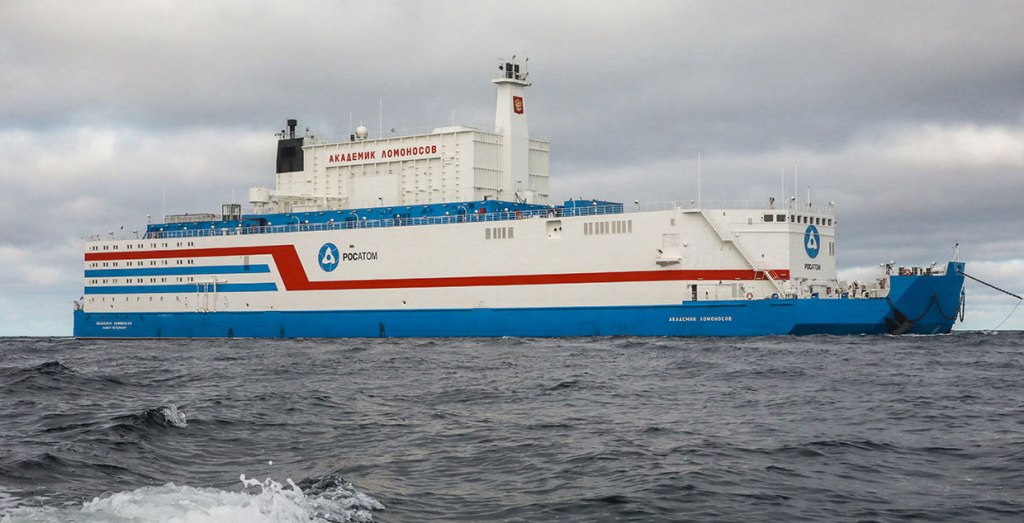
The floating nuclear power plant (FNPP) Akademik Lomonosov has been fully commissioned in Pevek, which is in the Chukotka region of Russia’s Far East. The milestone was made official following the approval of Rosenergoatom General Director Andrey Petrov. Rosenergoatom is the operator subsidiary of the state nuclear corporation Rosatom.
Petrov’s approval was possible after the regional branch of Russian regulator Rostechnadzor issued a “statement of conformity” for Akademik Lomonosov, which verifies that the FNPP had been inbuilt accordance with all project documentation requirements. Additionally, the project had received approval from Rosprirodnadzor, the chief authority controlling and supervising activities in the field of environmental management. Rosenergoatom said today that receiving these documents meant the FNPP “fully adheres to all or any norms and regulations, including sanitary, epidemiological, environmental, fire safety, construction requirements and federal standards”.
“Today we will consider the floating nuclear power plant construction project successfully completed. we have finished our main task for this year – fully commissioned the FNPP in Pevek, Chukotka region. Today, it officially becomes the 11th atomic power plant in Russia and also the northernmost one in the world,” Petrov said.
The FNPP, which comprises two 35-megawatt KLT-40C reactors, started providing electricity to the isolated grid of the Chaun-Bilibino energy centre of Chukotka on 19 December, 2019.
It has generated quite 47.3 GWh of electricity since being connected to the grid and currently covers 20% of the Chaun-Bilibino energy centre’s demand. it’ll become the most energy source for Chukotka following the shutdown of the Bilibino atomic power plant.
Its power and heat capacities are 70 MW and 50 Gcal/h (210 GJ/h), respectively. it is 140 metres long and 30 metres wide, and its displacement is 21,500 tonnes.
More than 50 U.S. companies are developing advanced reactor designs that will bring enhanced safety, efficiency and economics to the nuclear energy industry.
X-energy, located just outside the nation’s capital in Rockville, Maryland, is working on a pebble bed, high-temperature gas-cooled reactor that the company says can’t meltdown.
X-energy is developing its Xe-100 reactor and specialized uranium-based pebble fuel that could be available in the market as early as the late 2020s.
The U.S. Department of Energy has already invested more than $30 million through two separate cost-shared agreements to further develop their design and demonstrate a production process for its fuel.
Courtesy: energy.gov
How it works
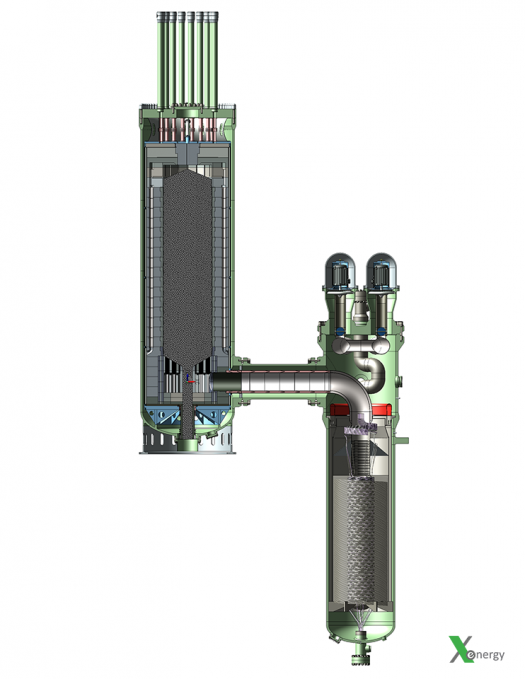
The Xe-100 is an advanced modular reactor with each unit designed to produce around 76 megawatts of electric power.
The reactor core is made of graphite and filled with 15.5% enriched fuel pebbles. Each pebble (roughly the size of a billiard ball) contains thousands of specially coated Tristructural Isotropic (TRISO) uranium fuel particles that are virtually indestructible.
The TRISO coating creates an airtight seal around the uranium kernel. This helps retain fission products and gases that are produced during operations and would allow the plant to be constructed within 500 meters of factories or urban areas.
The fresh pebbles are loaded in the reactor like a gumball machine and helium is pumped down through the pebble bed to extract the heat into a steam generator that produces electricity.
The reactor continuously refuels by adding fresh pebbles daily in at the top, as older ones are discharged from the bottom of the core. Each pebble remains in the core for a little more than three years and are circulated through the core up to six times to achieve full burnup. The spent fuel is then placed directly into dry casks and stored on-site—without the need for interim or active cooling.
Benefits of the Xe-100
The Xe-100 is designed to operate at high temperatures to produce electricity more efficiently. The high-temperature helium gas can also be used in energy-intensive processes that currently rely on fossil fuels, such as hydrogen production and petroleum refining.
COurtesy: Energy.gov
This reactor concept can also be designed to incorporate passive cooling through natural conduction, thermal radiation and convection in the case of a loss of helium coolant—meaning it doesn’t have to rely on large local water sources, pumps, or safety systems to prevent fuel damage.
This type of reactor technology brings in some added benefits like:
Ability to load follow (from 100% to 40% power within 20 minutes), making the plant complementary to maintaining a stable load on a grid that includes renewables
Continuous fueling and on-site fuel storage, delivering high availability (93-95%) while ensuring plant resiliency
Reduced construction time (2.5 – 4 years for a 300 MWe plant)
Factory-produced major components, enabling improved quality control while reducing per unit costs.
What’s Next?
X-energy is on target to have its basic design completed by 2021 and has successfully fabricated its first fuel pebbles using natural uranium at a pilot scale fuel facility, on-site at the Oak Ridge National Laboratory.
It is the only U.S. company actively producing TRISO fuel today and was awarded additional DOE assistance to design a commercial scale “TRISO-X” fuel fabrication facility and submit a Nuclear Regulatory Commission license application for the facility by mid-2021.
The company plans to complete TRISO-X Facility construction by the mid-2020s. Since the TRISO uranium particle is the basis for multiple advanced reactor fuel designs, the TRISO-X Facility could become a key enabler for deployment of the U.S. advanced reactor industry over the next several years.


 allaboutnuclear.tech.blog