

The 1250-tonne steel base of the cryostat – which will insulate the magnetic system at cryogenic temperature from the outside environment – has been installed at the International Thermonuclear Experimental Reactor (ITER) at Cadarache in south-eastern France. The milestone marks the installation of the first and heaviest component of the ITER fusion machine.
The operation marked the culmination of a ten-year effort to style , manufacture, deliver, assemble and weld one among the foremost crucial components of the ITER machine – the 30 metre high, 30 metre in diameter ITER cryostat (of which the bottom is merely one part). Procured by India, manufactured in segments by Larsen & Toubro Ltd at its Hazira factory, the cryostat is being assembled and welded on site under the supervision of the BARC and ITER India. the weather for the bottom section were delivered to ITER in December 2015 and therefore the component was finalised in July 2019. taking up from the Indian Domestic Agency, the Iter Organisation then proceeded with “pre-assembly work” before moving the component into the auditorium one month ago.
“The coming moments will stand call at the minds and memories folks all. What you’ll accomplish today, as a team, are some things that has never been done before in history – and although you’ve got rehearsed it repeatedly , it’ll be a first-of-a-kind operation,” said Iter Director-General Bernard Bigot at the beginning of the operation to put in the component. “We trust the engineering calculations, strategy and control. We trust the materials science. We trust the metrology. But my confidence today is because I trust you to figure together committed and highly professional team, convinced as we all are that failure isn’t an option.”
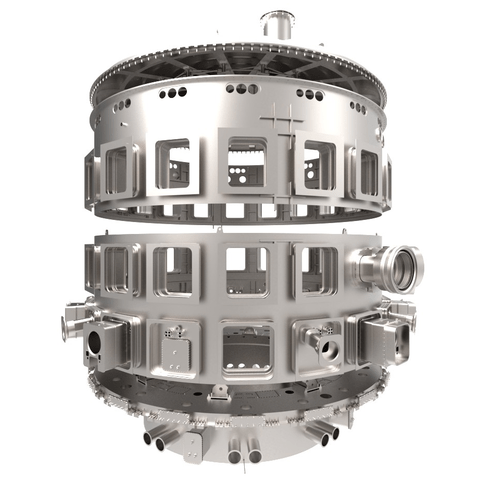
In an operation that started on the morning of 26 May, the bottom of the ITER cryostat was gradually lifted by crane from its support frame to a height of 24 metres. it had been then transported 110 metres from the doorway of the auditorium , passing above and over the 2 20-metre-high sector sub-assembly tools, eventually reaching the circular opening of the machine assembly pit. There, the cryostat base descended into the deep concrete cylinder onto 12 hydraulic jacks which will support its weight until final metrology and adjustments are performed and therefore the load are often transferred to the cryostat support bearings. The operation was completed on the afternoon of 27 May.

ITER is going to be a 500 MW tokamak fusion device (requiring an input of fifty MW) designed to prove the feasibility of fusion as a large-scale and carbon-free source of energy. the ecu Union is contributing almost half the value of its construction, while the opposite six members (China, India, Japan, South Korea , Russia and therefore the USA) are contributing equally to the remainder . The target for first plasma is 2025.
 allaboutnuclear.tech.blog